A dot as a beginning. What connects Andersen, happiness and our choices?

.
A dot usually ends a sentence. At YĀNAMI, it is a beginning.
The first gesture
The art lesson is coming to an end, and a blank sheet still lies in front of Vashti. She is convinced she cannot draw. Her teacher encourages her to leave just one mark and see where it takes her. Vashti makes a dot.
Yet this seemingly small gesture becomes the beginning of discovering her own possibilities. The sheet that was empty a moment ago becomes a place for something important. How often do we need that same encouragement to find out what we can do?
One dot can lead to more. From them come shapes, pictures and stories. What began with a single movement of the hand becomes something we give a beginning to. Something small can open a space that did not exist a moment before.
A pen, a sheet of paper and whole worlds
Let us imagine a table by a window. Heavy clouds gather outside, and dusk settles into the room. A candle lights the paper as a pen moves across it. A first sentence appears, then another. Ordinary objects become tools of imagination. This is how we might picture Hans Christian Andersen at work. From his imagination, written on ordinary sheets of paper, came so many beautiful tales we know: “Thumbelina”, “The Little Mermaid”, “The Ugly Duckling”, “The Emperor’s New Clothes”, “The Princess and the Pea” and “The Snow Queen”. Tales that generations have returned to for almost two hundred years. All he needed was paper and a pen.
A pen and paper were enough to give shape to what he carried within him. In his tale “The Pen and the Inkstand”, the two objects argue over who deserves the credit for creating poetry. It shows how ordinary our tools can be, and how extraordinary the things we make with them may turn out to be.
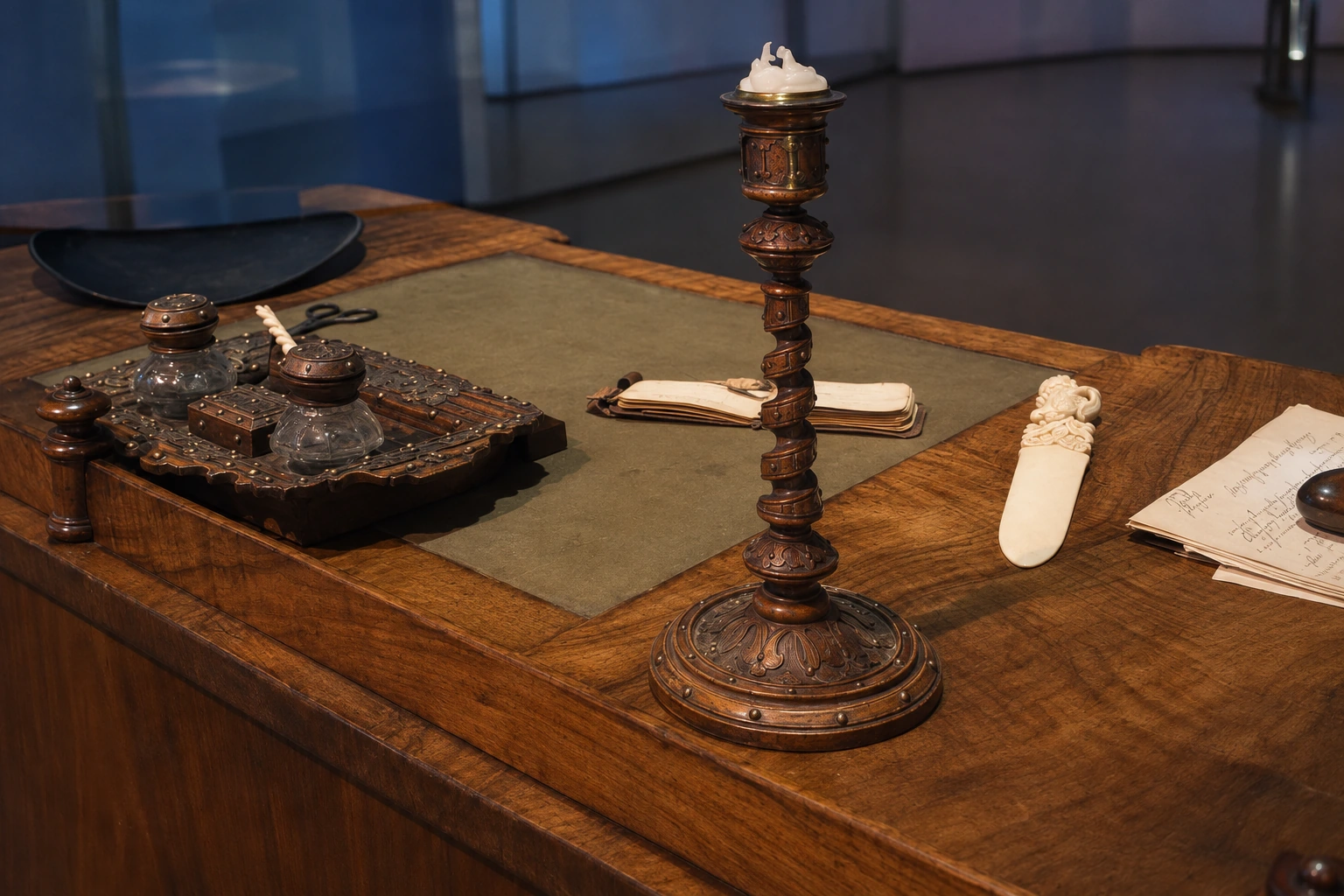
In the Andersen museum, the Ugly Duckling looks into the water and sees a swan in its reflection. It discovers who it is and where it belongs. Andersen recognised his own story in this tale. He knew loneliness and the need to be accepted. The museum’s narration gives us these words:
“This new world, the world in which you belong, will welcome you, and you will never be the same again.”
In Polish:
„Ten nowy świat, świat, do którego należysz, powita Cię i już nigdy nie będziesz tą samą osobą.”
Andersen had moments when even fame did not make him happy. Yet he created worlds that still move us today. We can begin bringing something beautiful into life while we still have things to work through.
Happiness and our choices
From the worlds written into fairy tales, we return to the one we live in every day. What makes it a good place for us to be?
Denmark, Andersen’s homeland, brings another association to mind: happiness. Danish people are among the happiest in the world. What supports that? Trust, a sense of security and the closeness of people we can rely on. Everyday life is easier to enjoy when we have that support. Being able to make decisions about our own lives matters too.
That possibility leads us to everyday choices. To what we agree to, what we give our attention to and what we make room for in our day. Our daily lives take shape through these decisions.
How often do we put off a beginning until everything falls into place? Until there is more certainty, more calm, a better moment. Yet we can make a first gesture even on a day with its own imperfections.
Our daily balance: 86,400
Imagine an account that receives 86,400 złoty every day. We can spend it on whatever we choose. There is one rule: at midnight, anything unspent disappears. We cannot save it for later or carry it into tomorrow.
How carefully do we now choose what to spend that money on? How often do we check the account to see what else we could do with it?
Now let us change the currency to seconds.
86,400 seconds. Twenty-four hours of our lives.
Every day we receive a similar deposit: 86,400 seconds. Twenty-four hours. Sleep, work, responsibilities, conversations and rest all fit into that balance. So do the moments spent on another comparison, another scroll, one more possibility to check. Each of these activities takes a moment.
It helps to know what we want to have time for. How much time do we give to what matters to us? How much to whatever happened to catch our attention?
How long can buying shampoo take?
Today, an abundance of possibilities surrounds us in many everyday matters. Ordinary shopping is enough to show it. You want to buy a moisturising shampoo. You do not even need to leave home.
You enter a search in an online beauty shop, and suddenly there are 391 results in front of us. Products, sets, more brands. We are looking for one product. We open descriptions, read ingredients and reviews. We compare prices. We want to choose well, so we check one more option.
What about the other cosmetics? Clothes, things for the home and everything we surround ourselves with every day?
We can draw on recommendations, specialist knowledge and help from AI. Tools can compare information and shorten the list of possibilities.
This applies to far more choices than shopping. Every day we decide what we agree to, whom we give our attention to and what we put off until later. How many of our everyday moments do we want to spend on things that do not matter to us?
This is where our own compass helps: our needs, values and priorities. When we know what we need, it is easier to recognise a suitable solution and stop searching. We can choose a shampoo that works for us and leave time for what we want to give greater meaning to.
We decide what matters. We also choose what to do with the moment we have saved. Perhaps we will give it to a conversation, a walk or an idea that has long been waiting for its first sentence.
What will we begin with one dot?
Let us return to Andersen’s pen and paper. Today our tools are different, but we can still create something of our own and give direction to the way we use them. Choose what we want to make, what to give our attention to and how to spend the moment we have recovered. Alongside ready-made possibilities are the ones we have yet to create.
We can choose from possibilities that already exist. We can also create our own. Write a few words that bring someone joy. Do something together. Give an ordinary gesture a meaning that makes it memorable. Create moments we give our full attention to. In this way, we give shape to the world around us.
This is how we build the world around us. Through the way we give someone our attention. Through what we create and share. Our choices take shape in everyday moments.
At YĀNAMI, a dot is a beginning. A point from which we move towards ourselves, our needs and the people we want to share life with. Towards moments we want to remember. With care for what we want to bring into our own lives and the lives of others. This is how we create a world of our own: through what we give time to and what grows from it.
Our own compass can begin with a simple question: what do I need today? Or: what do I want to give my time and attention to?
This moment is for you
Courage begins
when you allow yourself
to try a different way.
For a step towards the life you want.
You can draw on your own sensitivity, experience and imagination to create something good. For yourself. For those close to you. For the world we are part of. Perhaps a story. Perhaps an ordinary gesture that stays in someone’s memory.
Like Andersen, you can share something of your own with the world. One gesture is enough to begin.
A dot. Something beautiful can begin here.
Celebrate the moment. Celebrate life.
Sources and inspiration
- [1] Peter H. Reynolds, The Dot, Candlewick Press. Inspiration for the first mark on a blank sheet.
- [2] Royal Danish Library, From Hans Christian Andersen’s Own Hand; Hans Christian Andersen’s manuscripts and letters. Publication history and the characters of the tales.
- [3] Hans Christian Andersen, The Pen and the Inkstand (Pen og Blækhuus). Museum Odense, H.C. Andersens pen og blækhus collection.
- [4] Hans Christian Andersen Centre, University of Southern Denmark, The Timetable Year By Year, 1865. Andersen’s correspondence. H.C. Andersen’s House, The Dark Garden: loneliness in his life and work.
- [5] Helliwell et al. (eds.), World Happiness Report 2026, chapter 2. Denmark among the leading countries in life evaluations.
- [6] Frank Martela, Bent Greve, Bo Rothstein and Juho Saari, The Nordic Exceptionalism, World Happiness Report 2020, chapter 7. Trust, support, security and freedom to make choices.
- [7] Luca Mazzucchelli, 86 400 możliwości, translated into Polish by Zuzanna Juźwik, Bellona, 2024. Introduction. Inspiration for the daily account metaphor; the monetary example is adapted into złoty.
- [8] Screenshot supplied by the author. The query “szampon nawilżający” shows 391 results, including individual products and sets. The number refers to that particular view; the shop name is omitted.
- [9] Alexander Chernev, Ulf Böckenholt and Joseph Goodman (2015), Choice overload: A conceptual review and meta-analysis, Journal of Consumer Psychology 25(2), 333–358. DOI 10.1016/j.jcps.2014.08.002. The role of preference clarity in making choices.
- [10] Recording supplied by the author from H.C. Andersen’s House, in the exhibition devoted to The Ugly Duckling. The quotation comes from the last sentence of the English narration, approximately 18–26 seconds, and is followed by our Polish translation. An exhibition panel explains that Andersen recognised himself in his tale. The candlelit writing scene in this article is imagined.
- Royal Danish Library – Hans Christian Andersen’s manuscripts and letters. Supplement to source [2].
- H.C. Andersen’s House – The Dark Garden. Supplement to source [4].
- Luca Mazzucchelli – excerpt from the Italian edition of 86 400. Supplement to source [7].